Updated October 27, 2026
Two driveways poured the same week, one in Benbrook and one in Euless, can sit on completely different ground. Fort Worth is built across bands of limestone, clay, marl and sandstone that run roughly north to south, and the dirt under your slab decides how it behaves for the next thirty years. Here is what is down there and how we build for it. If you want us to look at your lot, call (817) 207-5579.
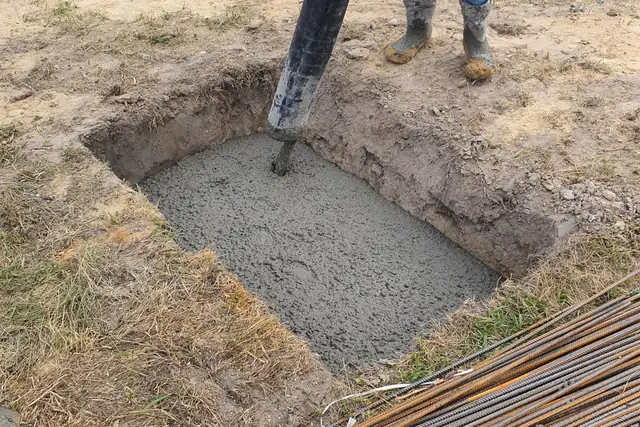
Why the ground changes across town
The rock layers under Tarrant County tilt down gently toward the east. That puts the oldest layers at the surface on the west side and the youngest on the east side. Going from west to east, you cross:
- Goodland limestone and Walnut clay: white, nodular limestone and limy clay with oyster beds, out in the western part of the county
- Fort Worth and Duck Creek limestones: limestone with thin clay layers
- Denton, Weno, Paw Paw, Main Street and Grayson: alternating clay, marl and limestone, with dark clay in the Paw Paw and chalky marl in the Grayson
- Woodbine: sandstone mixed with clay and shale in the east part of the county, under the Eastern Cross Timbers
- Eagle Ford shale: dark shale that weathers into the black clay of the Blackland Prairie, toward the Dallas County line
Between the two Cross Timbers belts lies the Fort Worth Prairie, where the soil is thin and sits right on hard limestone. In east Tarrant County the Woodbine soils tend to be sandy on top with clay below.
What expansive clay does to a slab
Clay soil swells when it soaks up water and shrinks when it dries out. North Texas gets both in the same year: a wet spring, then a summer when Fort Worth averages a high of 95 degrees in August. The edges of a slab dry out first and drop, or a wet spot under the middle lifts it. Concrete is strong when you squeeze it and weak when you bend it, so that movement shows up as cracks and tilted panels.
Clay also holds water against the bottom of a slab after a storm, and a downspout dumping on clay beside a driveway is a common cause of a sunken panel.
Call and we will look at your lot when we come to measure.
What limestone does to a slab
Limestone makes a firm base. The trouble comes from how uneven it is. A lot can have rock a few inches down on one side and a pocket of clay or old fill on the other, so the slab ends up sitting on two very different supports. Digging for a footing, a thickened edge or a pool deck may also hit ledge that has to be broken.
The clay and marl layers between the limestone ledges still move with moisture. A rocky lot is not automatically a stable one.
How we build for the ground we find
- We look at the soil when the old slab comes out, and we probe it at the estimate on new work
- Soft spots get dug out and replaced with compacted base
- On uneven rock, a layer of base evens out the support under the slab
- Rebar on chairs throughout, with heavier steel where the slab carries more weight
- Thickened edges on slabs that support a building
- Joints spaced close enough to control where cracks go
- Slopes and drainage that move water away from the slab and the house
For a room addition or anything that holds up a structure, an engineer designs the foundation for that lot. Fort Worth requires compacted subgrade at 95 percent of standard Proctor density for the approach in the city parkway, and we hold driveways to the same idea.
Weather on top of the soil
Heat is the other half of the story. On a hot, dry, windy day the surface of fresh concrete can lose water faster than it should, which leads to shallow cracks before the slab is a day old. In summer we start pours at daybreak, keep the finishers moving and spray curing compound as soon as the finish is done.
Freezes are rare but they happen. In February 2021 the temperature at DFW Airport fell to 2 below zero on February 16 and stayed at or below freezing for 139 straight hours. Keep deicing salt off concrete in its first winter and use sand instead.
Questions about Concrete on Fort Worth soil in Fort Worth
- How do I know what soil is under my house?
- Your home's foundation engineering report, if you can get it from the builder, names the soil. A free online source is the USDA Web Soil Survey. We also look at what comes up when we dig.
- Does rebar stop concrete from cracking?
- No. Rebar holds the pieces together and keeps cracks tight and flat when they happen. Joints decide where most cracks form.
- Should I water around my slab in a drought?
- Keeping the soil around a slab from drying out to extremes helps, and so does keeping sprinklers and downspouts from flooding one spot. Even moisture is the goal.
Call us, or send the form, and we will set a time to look at the job and price it in writing.